

For many small businesses, employee benefits are more than just a nice extra. They can make it easier to hire, keep good staff, and support people when they need help with health costs, time away from work, or long-term planning. The challenge is choosing a plan that fits a small team and a realistic budget.
In Canada, there is no single benefits package that works for every business. What makes sense depends on team size, employee needs, budget, province or territory, and whether the business wants a traditional group plan, a flexible spending option, or something simpler to start with.
Why Employee Benefits Matter for Small Businesses
Salary is only part of compensation. Benefits can help employees feel more secure and make a job offer more competitive, especially when larger employers are offering broader packages. Even a modest plan can make a difference if it covers the things employees use most, such as prescription drugs, dental care, or mental health support.
Benefits can also reduce financial stress for employees. That matters in a small workplace, where one person’s absence or burnout can affect the whole team. A thoughtful plan does not need to be expensive or complex, but it should be easy to understand and relevant to the people on the team.
What Small Businesses Commonly Offer
Many Canadian small businesses start with core health and dental coverage. A typical plan may include some combination of prescription drugs, basic dental services, vision care, and paramedical services such as physiotherapy or massage therapy. Coverage levels vary widely by provider and plan design.
Some employers also add life insurance, accidental death and dismemberment coverage, and disability insurance. These benefits are often more important than they first appear because they help protect employees and their families if there is a serious illness, injury, or loss of income.
Mental health support is increasingly common. This may come through an employee assistance program, counselling coverage, virtual care access, or broader wellness benefits. For some teams, these services are highly valued and may be used more often than traditional extras.
Retirement-related benefits can also be part of the package. A group RRSP is a common option for small businesses because it is usually simpler than a pension plan. Some employers match employee contributions, while others simply make payroll deductions available through the plan.
Another common option is a health spending account or wellness spending account. These arrangements can give employees more flexibility than a fixed plan design. Instead of relying on a long list of preset coverage rules, the employer sets an annual amount that employees can use for eligible expenses, subject to tax and plan rules.
What Small Businesses Are Legally Required to Provide
In Canada, most extended employee benefits are optional. Employers are generally not required to provide private health, dental, disability, or life insurance plans. What is legally required usually relates to employment standards, payroll programs, and workplace protections rather than extended benefits.
Requirements can include workers’ compensation coverage, Employment Insurance, Canada Pension Plan or Quebec Pension Plan contributions, paid vacation, public holiday pay, job-protected leaves, and provincial or territorial sick leave rules where applicable. These are not the same as a group benefits plan, but they are part of the broader employee support picture.
The exact rules depend on the province or territory and on the nature of the business. That is why it is important not to assume one province’s rules apply everywhere. If there is any uncertainty, it makes sense to confirm obligations with a qualified accountant, employment lawyer, payroll provider, or government source.
Even when benefits are not legally required, some are often expected in the market. That is especially true for full-time roles in professional, technical, administrative, and skilled positions where candidates may compare offers closely.
How to Choose the Right Benefits for a Small Team
Start with Employee Needs
The best plan starts with the team, not the brochure. A younger team may care more about mental health support, virtual care, or dental coverage. A team with families may place more value on drug coverage, dependants, and vision care. A business with physically demanding work may want to look more closely at disability coverage and income protection.
It helps to think about how employees are likely to use the plan without making assumptions about personal medical situations. A simple anonymous survey can be useful if the team is comfortable with that approach.
Set a Realistic Budget
Benefits need to be sustainable. A plan that looks generous at the start can become a problem if renewal increases make it hard to maintain. It is usually better to begin with a package the business can keep than to introduce rich coverage and later cut it back.
Budget decisions also include cost sharing. Some small businesses pay the full premium for certain benefits and ask employees to contribute to others. There is no single right split. What matters is being clear about the cost, the value of the plan, and what the business can support over time.
Choose Between Fixed and Flexible Options
A traditional group benefits plan offers structured coverage with defined limits, deductibles, and co-insurance. This can work well when the business wants a familiar package and has enough employees to qualify for a standard plan.
Flexible options, such as health spending accounts, may suit smaller teams or businesses that want more control over costs. They can be easier to manage in some cases, but that does not automatically make them better. The right choice depends on team size, cost predictability, tax treatment, and how much administration the business is comfortable handling.
Balance Coverage with Usability
Higher coverage is not always better if the plan is too expensive or too restrictive to use. In practice, a strong plan often comes down to a few key design choices: what is covered, what percentage is reimbursed, whether there is a deductible, and whether there are annual or lifetime maximums. The goal is to create something employees will actually use and understand.
How Benefits Pricing Works
Pricing for group benefits in Canada varies by provider and plan structure. Premiums are often affected by factors such as the number of employees, the ages of covered members, the types of benefits included, the industry, claims experience, and whether coverage is employee-only or includes dependants.
Some benefits are more predictable than others. Life insurance pricing, for example, tends to work differently from health and dental, and disability coverage has its own underwriting and eligibility rules. Very small groups may have fewer options or may be priced using simplified pooled models rather than fully customized rates.
There are also tax and payroll considerations. The tax treatment of employer-paid benefits can differ depending on the type of benefit and the province or territory. Because those details can affect both the employer and employees, it is worth confirming them with an accountant or qualified benefits advisor before finalizing a plan.
When a Business Is Too Small for a Traditional Group Plan
Some small businesses are simply too small to access the kind of group plan that larger employers use, or the pricing may not be practical yet. That does not mean there are no options.
For very small teams, businesses often look at individual coverage, health spending accounts, or association and pooled-style options where available. These can be useful stepping stones for a company that wants to offer something meaningful before it is large enough for a broader plan.
Each approach comes with tradeoffs. Individual plans can offer good personal coverage, but they do not always create the same shared employer-sponsored experience. Health spending accounts can control costs well, but they may not replace disability insurance or other core protections. Pooled options may improve access, but plan design and eligibility can be more limited. The best fit depends on what problem the business is trying to solve first.
How to Compare Providers and Plans
Comparing benefits providers is about more than price. A lower-cost plan is not necessarily better if claims are hard to submit, coverage rules are confusing, or support is poor when employees need help.
It helps to look at the provider’s claims experience, online access, mobile tools, customer support, enrolment process, and renewal practices. Businesses should also review contract terms carefully, including waiting periods, eligibility rules, exclusions, cancellation terms, and how rate changes are handled at renewal.
Good questions to ask include whether the provider works well with small groups, how claims are processed, what support is available during onboarding, and how plan changes can be made later. If a broker or advisor is involved, it is also reasonable to ask how they are compensated and what ongoing service they provide after the plan is set up.
A few details deserve extra attention:
- Fit for Your Team Size: Some plans are built with smaller employers in mind, while others make more sense once a company grows. A provider that works well with small groups may offer a simpler setup, more practical plan options, and fewer surprises.
- Claims and Admin Experience: If claims are frustrating or plan administration feels clunky, the plan can create more friction than value. Easy claims, clear member tools, and simple admin access are worth paying attention to.
- Flexibility Without Unnecessary Complexity: More options are not always better. For a small team, a provider that offers practical core coverage or flexible add-ons like spending accounts may be a better fit than a plan loaded with extras nobody uses.
- Support at Setup and Renewal: Good onboarding matters, but so does what happens later. It helps to know how the provider handles enrolment, plan changes, and renewals before anything is signed.
- Clear Tax Guidance: Some benefit arrangements may be non-taxable when structured properly, while others may create taxable benefits. A provider or advisor that can explain that clearly can save a lot of confusion later.
How Small Businesses Typically Set Up Employee Benefits
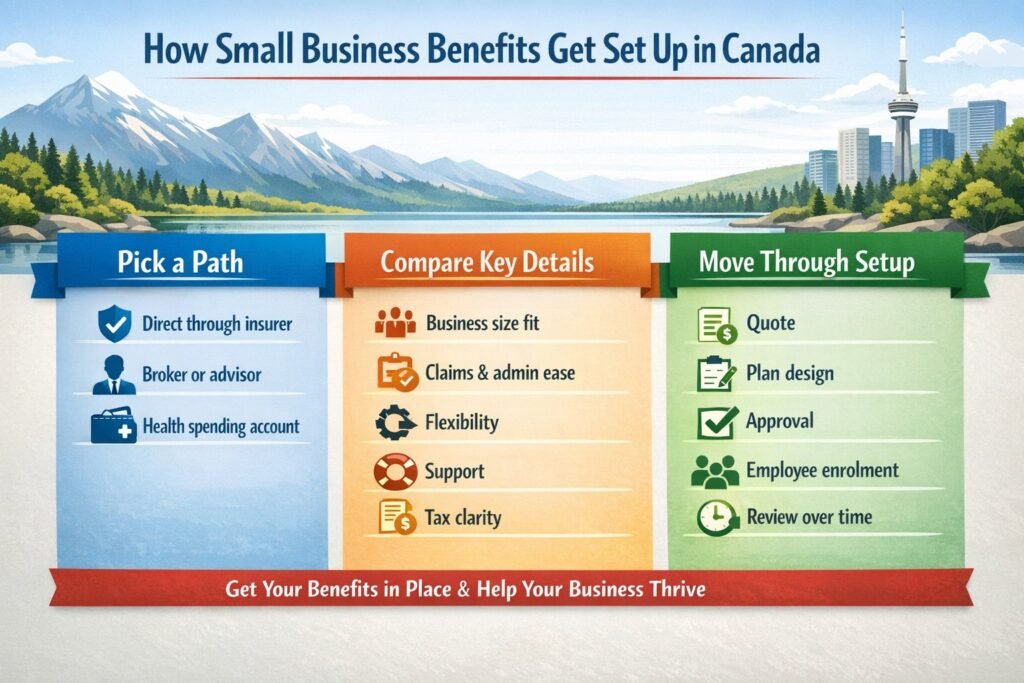
Once a business has a sense of the coverage it wants, the next step is usually deciding how to buy and manage the plan. In Canada, that often means going directly to an insurer, working with a licensed broker or benefits advisor, or choosing a simpler option such as a health spending account provider. In many cases, the process starts with a quote or advisor conversation, then moves into plan design, enrolment, and ongoing administration.
- Direct Through an Insurer or Provider: Some businesses go straight to a benefits company that offers small-group plans or options such as health spending accounts. This can work well when the business already has a clear sense of what it wants and prefers to deal directly with one provider.
- Through a Broker or Benefits Advisor: Others prefer to work with a licensed broker or advisor who can compare options and explain tradeoffs across providers.
- Quote, Plan Design, and Setup: The provider or advisor will usually ask for basic business details, team size, eligibility, and the types of coverage the business wants to offer. From there, the plan is priced and structured based on those choices.
- Enrolment, Administration, and Review: Once the plan is approved, employees are enrolled, coverage details are shared, and someone at the business usually handles basic administration. Online tools for enrolment, plan changes, and claims support are now a common part of that experience.
How to Roll Out a Plan Successfully
Even a strong benefits package can fall flat if employees do not understand it. Clear enrolment and onboarding matter, especially in a small business where there may not be a dedicated HR team.
Employees should know what is covered, when coverage starts, how to add dependants, how to submit claims, and what the plan does not cover. Plain language helps. So do simple examples of how the plan works in real life.
It is also worth reviewing the plan every year. Team needs change, provider offerings change, and costs change. An annual review gives the business a chance to adjust coverage, confirm whether the plan is still competitive, and catch any problems before renewal becomes a surprise.
Common Mistakes to Avoid
One common mistake is choosing based on price alone. Another is buying too much complexity for a small team. A plan should match the size and stage of the business.
It is also easy to overlook disability coverage, mental health support, or the tax side of benefit design. Some businesses focus heavily on health and dental while missing the protections that matter most during a serious illness or income interruption.
Poor communication is another common problem. If employees do not understand the plan, they may undervalue it or use it incorrectly. That can lead to frustration even when the coverage itself is reasonable.
Finding the Right Employee Benefits Provider in Canada
After weighing those factors, the right provider is the one that fits the business, the team, and the budget while making the plan easy to manage. For some small businesses, that will mean a traditional insurer. For others, it may mean working with a broker to compare options, choosing a health spending account provider, or going with a simpler setup designed for very small teams.